
Asian diaspora businesses are on the rise!
The two leading Asian nationalities with the Asian diaspora in the United States are the Chinese and the Indian: They have the highest education attainment for Asian minorities, if not also all minorities, so have jobs with advanced experience and middle to high-class incomes. A distant 3rd minority group is the Arab one, primarily Lebanese and Egyptians, scattered over Michigan, New York, and California.
This is a great opportunity for global businesses and start-ups.
The Chinese and Indian diasporas now migrate in steady numbers and many also plan on remaining in the US—for business, education, or other reasons—or returning to contribute to their countries. So, brain drain does not apply much now—it is accurately brain expansion. The goal is to see migrants as a global, fluid diaspora that can give back.
Silicon Valley is the most common example of successful Chinese and Indian migrants.

Not only are their economic and technical contributions to Silicon Valley recognized, but their future potential is only also increasing. Their deep immersion in technical jobs, which require advanced (frequently STEM) education, means they are a great conduit of traffic and business. Chinese immigrants in those high-skilled jobs have more exposure and education than their fellow Chinese workers in other industries, such as peddling, hospitality, inn-keeping, or shopkeeping in Los Angeles and Chinese enclaves in other US cities. The multiplier effect is the importance of diasporas in leveraging their home countries in international business. As such, the Chinese, Indians, and, to a less extent, Arabs have cultivated an extended, at least bi-cultural, network of contacts and other important resources.
Therefore, key sectors where Chinese and Indian businesses can benefit or be instrumental:
Education: The number of young adults approaching graduation from emerging markets, especially China and India, is staggering so companies and entrepreneurs can offer language and preparatory courses. Lumiere Education in the US, Edx in Boston, and Toppr in India are examples.
Transportation, Visa assistance, and networking: These are institutional or industry gaps waiting to be filled.Pony.ai in China and Sharechat in India are examples.
Food and delivery: Milkbasket in India is a major example.
Medical services: Online booking and inquiries in medicine are becoming more popular. Doctor Insta. in India is an example.
A shared factor among Indian, Chinese, and Arab societies is the tribal culture and values. This is the loyalty to the family, superseding state, civic, or political institutions or imperatives. Related to this is the marked tendency in many Asian societies to conform or seek consensus (rather than deliberate).
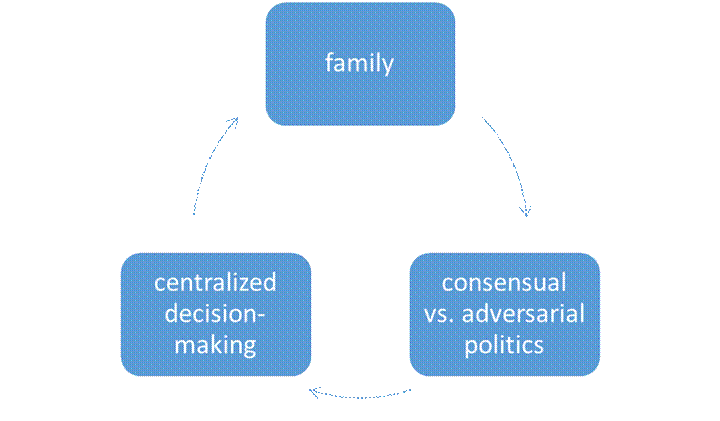
Centralized decision-making is when families make decisions as a family or collective unit. This is a pervasive phenomenon in many Asian societies, such as the Arabs, Chinese, and Indians. Families act as “one” coherent unit. So, businesses can capitalize on the strong family links in those three diasporas by focusing on referrals and online services, such as medical services, education, transportation, and others.
In a general sense and the “big picture,” diasporas are part of cultural life and identities, can facilitate traffic with their host societies, can help represent the host society or minority population, and a myriad of other benefits. With globalization and social media, diasporas can assume ever-greater roles in development, cross-cultural education, political mobilization, and other areas. What adds impetus to this cultural and demographic nexus is the contestation and dialogue that can happen along three dimensions:
Media and Funding: They are vital for representation, giving voice to people, and helping affect public opinion. Having access to such powerful institutions as “the media” is indispensable for minorities. The case of the Hispanic diaspora is telling in that it has institutions in Hollywood that represent their interests and there are increasing numbers of them working in the industry and vying for “entry.” Of course, how “successful” they are, or have been, is a matter of subjective opinion.
Social Sciences: Building online and offline communities is crucial for minorities. They can establish a collective identity, so they can communicate with their home countries, host countries (primarly the US and Britain), and amongst themselves. Minorities can harness social media and technology to cultivate a digital, cross-country presence, which can only support their efforts and activities in other sectors or domains. Social sciences encompass writing, journalism, blogging, political science, philosophy, some pillars of business, and others.
Legal Empowerment
Strategy Surgery & Consulting can help you with your business or company needs or challenges. Reach out to us for a free consultation.