In the age of technology, one observation is definite: Arab television and Web production are making strides. Major players in the industry are Roya Television in Jordan, Imagenation in the United Arab Emirates, Al-Jazeera, and Doha Film Institute in Qatar. Imagenation, the only corporate entity in the Arab region that finances films, is now developing television series. This is a development from originally producing only Arab films.
Arab television production is getting a push. Imagenation now has an ongoing roster of television shows—Qalb Al-Adalah (Justice), UAE Youth Ambassadors, Chance of a Lifetime, My Military / My Life, and others. Netflix, the premiere online streaming and rental service, has now also acquired Justice for online streaming (available as of January 2019). Lebanon produces television series and Egypt produces both films and television, especially when Turkish series were dubbed for Arabic audiences.
Many YouTube channels have also sprung up touting Arab content and everything from news channels, individual actors or figures, to shows—Kharabeesh, Roya TV, the Saudi Sa7i, The Voice, Arab Idol, and others. Such content is decidedly diverse, but most is audience-based or interview-based. Roya TV has an entire portfolio of shows ranging from cooking and kitchen work, youth-focused, a live stream, a news channel, and series. It has almost 613000 YouTube users as of January 2019. Kharabeesh produces animated shows and has more subscribers than Roya TV.
What all this points to in both film and television is an increasing quantity and appetite for “media”, and higher production values. When the Emirati government launched Imagenation in 2009, it sought to create progressive, artistic, and at least regionally competitive content, with very high production values. It rolled out an ambitious mandate encompassing partnerships with leading media companies, which resulted in films, such as Flight, Contagion, Best Exotic Marigold Hotel, Zinzana, and Roman Israel.
This all continues the journey to modernize the film industry and produce regionally competitive content– but there are several caveats. The youth population is increasing, technology and smart-phone penetration is increasing, and customer tastes are evolving.
1) Mainstream Audiences Prefer Non-Arabic Films
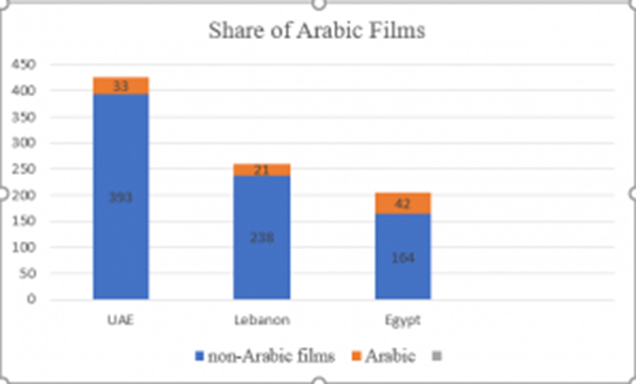
Egypt, Lebanon, and the UAE have the largest number of theaters in the Arab market, while Egypt has the greatest number of Arabic (almost entirely Egyptian) films. Egypt also has protectionist foreign film importation regulations, one of the factors behind the dominance of Arabic films there. Saudi Arabia has plans to build and license more cinema screens, supposedly leading to a market potential of $1.2 billion.
Source: Mideastmedia.org
Source: Mideastmedia.org
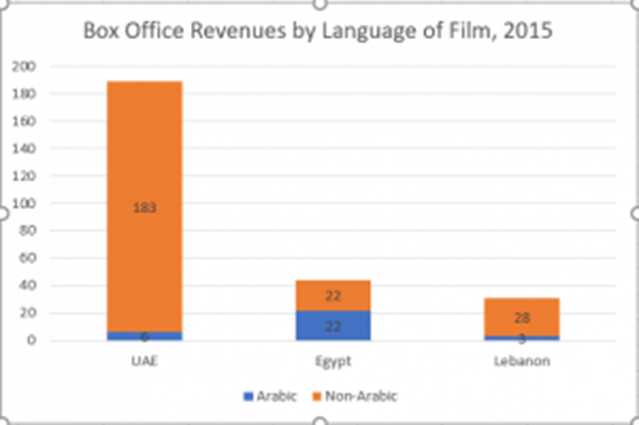
What the above show is that audiences still favour foreign, meaning Hollywood in this case, films. Egypt has by far the most productions. UAE and Lebanon have such diversity but audiences prefer foreign fare. A reason is that the UAE and Lebanon have diverse, fairly educated, populaces, with expatriates in UAE comprising more than 80% of the country’s population. So, with Egypt’s dominance, the other film regimes of the region- Lebanon and UAE– have to gain public sector support to become regionally competitive, mainly financing.
Furthermore, while UAE, as exemplified by Imagenation, does not compare to the production capacity and density of Egypt, it has now invested millions of Dollars in film production and distribution. It will take time for the country to produce and distribute content that is competitive on a regional level.
2) Television Is the Next Emerging Market
Studies show that television has huge potential in terms of advertising and number of television shows that can fill its air times. Given the uneven distribution of cinemas in the Arab market, television production is in a better position to generate profits and capitalize on such a huge, diversified market. Egypt and Lebanon have the greatest numbers of cinema screens, meaning any film would need to screen there to generate enough ticket sales. This leaves television and Internet-based content promising.
3) There Is a Strong Need to Diversify the Offerings
YouTube, online streaming, and piracy are drivers now of film and television viewing. While cinemas in Saudi Arabia and more production from UAE are great signs, the proliferation of channels and viewing patterns means a need to diversify offerings. Audiences may want more IMAX films, children’s films, family shows or television series, and others in the near future. There is no one-size-fits-all. IMAX’s expansion to the Arab region is a step forward—the rest is a mix depending on audiences’ tastes and infrastructure advancements.
4) The Media Labor Market is Divided Along National Lines
The composition of the labor market in the GCC, and other Arab countries to different levels, shows that Lebanese predominate in the media field. It can, thus, “open up” and be inclusive of other nationalities and voices. This is a bi-directional process– the more people erode such ethnic and national barriers, the more enriched the field becomes.
- Pakistanis and Indians are in accounting and IT
- Palestinians and Jordanians are in engineering and medicine; and
- Mostly Lebanese are in creative professions (advertising, media, marketing, and public relations)
National boundaries are clearly salient. Many people in the Doha Film Institute, for example, are Americans, Moroccans, Indians, and Lebanese; most in the advertising field are Lebanese. A highly informed and experienced source, who declined to be identified by name or position, said, “It is definitely dominated by the Lebanese, especially when it comes to management positions. So, I’d say the management positions are probably 80% Lebanese, for sure. About 80% of management or top positions in both media and advertising are definitely for the Lebanese.”
This is slowly changing, though, with globalization and technology, and more people getting advanced education. Traditional careers or professional roles are gradually changing in response to such changing demographics and migration. “There are more and more nationalities entering this [the media field]. I’d say the Syrians, the Palestinians, the Indians. Even locals, let’s say Saudis in Saudi Arabia, Egyptians in Egypt, or Kuwaitis in Kuwait. But still, it [the field] remains very, very dominated by the Lebanese,” the source said.
The reason behind this phenomenon is that the Lebanese were prepared for it and introduced its tools and vision. “They are, honestly, in general better than others in that,” the source said.
This reality can remain a market barrier, depending on popular and professional awareness and changing industry trend. So, addressing such national barriers or clusters can definitely enrich the field, and promote more recognition of it outside its core practitioners.
5) The Need to Further Institutionalize the Field
The UAE, Lebanon, and Egypt lead the way in institutionalizing the media field, as in universities teaching it, active festivals, and production companies or entities financing films and television. UAE is a progressive, wealthy monarchy, so launched Imagenation to support cinema. UAE has SANAD Fund, Dubai Film Fund, and, of course, Imagenation.
The American University of Cairo has the Department of the Arts, within the Faculty of Humanities and Social Sciences. That department teaches all aspects of film and media. The American University of Beirut has a Media Studies Department. Lebanon has historically had a film regime, but the Civil War slowed it down and Lebanese films rely heavily on European financing. Egypt is the leading film industry in the region.
Thus, a key market, if not the most important one, is the GCC. Saudi Arabia needs time to promote the field and institutionalize it since the vision exists. Its ongoing Vision 2030 promises reform and the cultural and artistic development of the country. The root of the phenomenon is a social and cultural view that “media” and the arts are simply hobbies and creative endeavors, not “hard fields” that one may pursue.