
The publishing sector in the Arab region, as of 2019, shows mixed phenomena and indicators. Saudi Arabia, Lebanon, Egypt, and the United Arab Emirates are the key countries in it. The Arab region is at the crossroads of several trends:
A sector that can have a key role in national education and human resource enhancement is book publishing and distribution. The book publishing sector in the Arab region is uneven in that three countries, Lebanon, Egypt, and recently Iraq, dominate it by:
* The number of publishing houses,
* The number of published titles, and the
* The number of writers (especially Arabic-English)
At the same time, it is not one of the sectors that contribute much to national Gross Domestic Product even though its abstract market value may suggest a “high” number, as in $100 million to $150 million according to an Arab News article. E-books are on the rise, giving access for millions of readers, including those who read Arabic only, to potentially millions of titles.While the book publishing sector usually implies book publishing and distribution only, several activities comprise it:
Publishing Industry: Publishing and distribution houses exist in every Arab country, mainly Egypt, Lebanon, and Iraq. Consumers in these three countries read and write in Arabic, English, and French. Readers in the United Arab Emirates (UAE) and Saudi Arabia read English depending on their nationality and their age group, and these two countries are also important by dint of their purchasing power and the size of their markets.
Genres: Arabic literature, religious books, and self-help are three highly popular genres in trade books in the region. Authors from Egypt, Syria, Lebanon, and Iraq have published Arabic literature. The region is also home to many prestigious literary awards.
Translation: There is occasional translation and in key Arab markets, Egypt, Lebanon, Morocco, Syria, and Saudi Arabia. Most experienced translators are in Lebanon, Morocco, Algiers, and Egypt and the market for translation depends on the languages in question and the type of book.
Academic Publishing: The market for academic books is huge, especially in Saudi Arabia.
Digitization and social media saturation, which have led to Arab readers’ increasing exposure to English, have engendered both opportunities and challenges. At the organizational front, book publishing many Arab countries falls under “media and information” laws, meaning is not “an industry,” so many (not all) Arab governments do not subsidize it and the sector does not contribute much to their national GDP, let alone national development and education. It falls under “media and information” also because some governments understandably perceive it as content that may carry inappropriate material for the public. Another factor is that, according to the book that the Arab Publishers’ Association in Egypt commissioned, 65% of book publishers the author had surveyed showed organizational fluidity—little or no differentiation between the different, successive functions of the publishing process, encompassing concept, contacting the agent or author, editing the manuscript, to verifying its accuracy, to marketing it—so these functions “merged” into the manager or owner of the publishing house. The logistical work was practically manuscript editing. So, there is both a logistical and cultural reason behind the “mixed bag” of indicators for the sector.
Beyond these two overarching factors, several factors color or animate the book publishing sector in the Arab region. Censorship, major gaps between readers of Arabic and of English, purchasing power, and competition from online vendors (such as Amazon) have rendered unpredictable or incomplete a portrait of the sector. Despite significant changes in the book sector, such as the emergence of e-books, PDF books, and online vendors, there is little official available information on such key indicators as reader rates, average price of a book in a given genre, or the number of e-books a reader purchases or downloads from a given website (such as Abjjad.com).
Strategy Surgery and Consulting conducted early field work from 2019 and incorporated research from a consultant whom the Arab Publishers’ Association in Egypt contracted, to arrive at a snapshot of the book publishing sector. Some statistics or numbers remain constant:
* Most book publishers are in Egypt, at ~ 1, 300
Most book publications were in Lebanon at 8300 to 8500 before the bank crisis. Now, 2019, they are 3500 to 3600.
Technology has instigated the emergence of many online book vendors: Abjjad (Jordan), Rufoof (UAE), Kitab-Arabi (based in the United States), Asser Alkotb (Egypt) Books-library.net, Kutub, Ektab (Jordan)
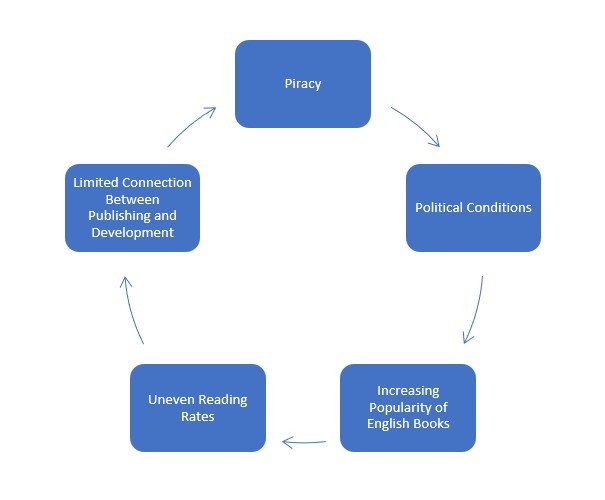
While digitization and online books have become a rising opportunity, there are challenges:
Piracy
The different political circumstances of each Arab country, especially among the Western and Eastern Mashreq
The predominance of books in the English language available online on Amazon, leading to a need to reconsider the number of titles every year in English and Arabic
Uneven reading rates among readers in the different Arab countries.
A popular perception in many countries that book publishing falls under “media and information,” so does not warrant the resources or labor that a mature publishing house needs.
Reading and publishing are not new in the region. Iraq, Lebanon, and Egypt have had a long book publishing sector since 1950s. What is new as of the Internet boom are:
* An increasing number of e-publishers
* Increasing numbers of English readers
* Difficulty estimating download rates vs. actual readership rates for e-books
What the Arab region is witnessing is gradual replacement by e-reading of traditional reading and the printed book, a trend that the young generations are spearheading. Technology and social media are enshrining the ease of publishing, its convenience to readers, and its lower cost than traditional books and publishing. Ebooks are facilitating the process and saving money. Therefore, e-books are a new platform for and a crossroads between digitization and publishing.
What remain, therefore, are strategic opportunities:
* Publishers, depending on their budgets and resources, can begin investing in data analytics and customer / reader segmentation. This would be a good opportunity for and step towards book recommendations and ultimately higher sales.
* Electronic books sales of classic titles in Saudi Arabia and the United Arab Emirates rose by 14% within the span of 2021, according to a news article.
* Digitizing "old" existing titles, such as classics from Arabic literature or religious books.
* The strong need for longitudinal, regular surveys of Arab readers for customer segmentation.
With a few exceptions, there is no such strategic activity. Therefore, the future is bright for e-publishing in the Arab region and its diaspora as it is for many other digital or e-transactions. Investors and publishers can invest in analytics and reader research to best harness these opportunities.
For more information or a consultation, contact Strategy Surgery & Consulting here or reach out at info@strategysurgery.com.