June 15, 2019
Higher education consulting is becoming an institutional need with technology permeation, the growing student population, and the plethora of academic programs. The student or young adult population in most, if not all, the Middle East and North Africa (MENA) region is a major growth factor for the higher education sector. Countries like Saudi Arabia and the other Gulf Cooperation Countries (GCC) have the resources for spending on higher education. With the exception of the GCC, the supply of labour (i.e., job-seekers) in MENA, as of 2017, is not “catching up” with the rapidly evolving and increasingly technology-driven job market. As a result, MENA has a conspicuous competencies gap, between what employers need or would like, and what most job-seekers have to offer. A 2017 Bayt.com study revealed the percentages of employers in several Arab countries who reported such a gap[1]:
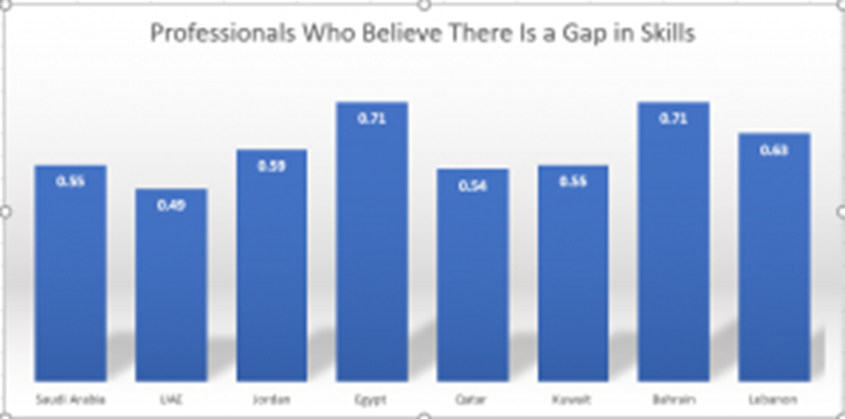
Jordan and Saudi Arabia, as examples and as of 2017, have a surplus of engineers and medical doctors. Many of those in Jordan are already un- or underemployed and people in other jobs are forced to find employment in temporary jobs, like driving for Uber or Careem. The construction sector in Jordan and Saudi Arabia has been extremely slow since the oil slump in Saudi Arabia. The result has been a double-whammy—over-saturation of engineers and doctors and extremely slow job and economic growth. Al-Ghad, a premiere newspaper in Jordan, has been reporting that upgrading and improving the university system in Jordan has become a pressing priority[2].
Higher Education: A Microscopic View
The roots of this higher education phenomenon are deeply seated. There is a clear schism between the private sector and higher education in many Arab countries depending on the person’s major. The number of university graduates in the GCC and non-GCC is only increasing. Professionals in accounting, engineering, and medicine have been unemployed, sometimes for over a year, or have “moved on” to other jobs. Many drivers for Uber and Careem have been searching for other, full-time jobs. Many majors in universities, such as renewable energy engineering, marketing, and human resource management, are not “mature” yet, as of 2017, since the market for them is too small. Saudi Arabia, the biggest Arab market for all sectors, does not have many jobs for such a major, as Bayt.com shows. Several new majors are emerging without respective jobs in the private or public sector. These are gaps that represent opportunities. The Gulf Cooperation Countries (GCC) have different circumstances. Whether local, national universities there or foreign ones, they are much better positioned to capitalize on the growing student population.
Other factors of the higher education system complicate the problem. Families expect and entice their children to become engineers or Doctors, as a matter of culture and tradition, and the institutional maturity of many other fields is low to moderate. Examples are, with no order, marketing, computer science, sociology, data science, political science, nutrition, and even new specialities in engineering. Students also typically cannot afford a graduate education and they urgently need to work after college, if not also during college.
Another issue with higher education is that many students “pick” their majors based on their senior year’s grades, not their career – professional interests or talent profile. The Jordan Ministry of Higher Education, for example, stipulates that a student needs a minimum overall average to qualify for engineering, pharmacy, or medicine. Any averages below those thresholds “relegate” the student to any other major—business administration, nutrition, economics, and others. Furthermore, the technology revolution, again as of 2017, is rendering some job functions obsolete altogether or outdated, such as sales, market research, and others[3].
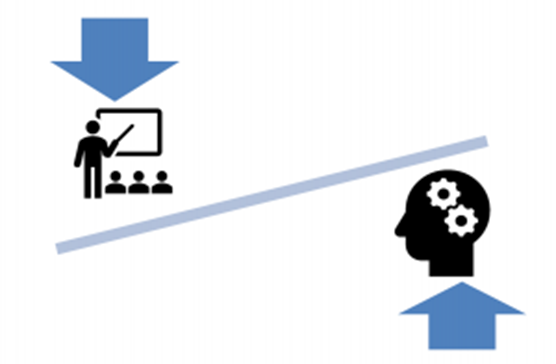
Two other factors affect the cycle between the higher education sector and the private and public sector but do not fall within a “consulting” prism —the predominately small middle socioeconomic class, and students’ very academic preparation. The market for higher education has not burgeoned yet if we measure it exclusively by per capita or family income. Even in the GCC, the percentage of students who can afford to study in private, typically Western, universities, is very small. The other factor, academic preparation, is almost equally important. Few Arab students (as opposed to Pakistanis or Indians) in Saudi Arabia, Jordan, Syria, and the United Arab Emirates speak English well enough to undertake education in an English-speaking institution.
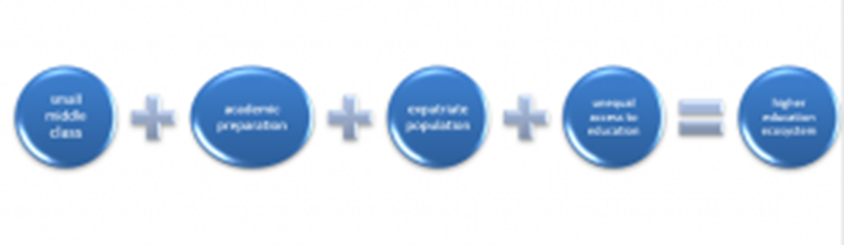
Related to the first factor is the huge expatriate population in Saudi Arabia, UAE, Bahrain, Kuwait, and others. Many Saudis, for example, are employed in the public sector and have relied tremendously on public education, health insurance, and other services. Related to that is that there are many Egyptian expatriates in Jordan, for example, attesting to the understandable phenomenon that nationals prefer certain jobs or professional status.
Areas of Focus in Higher Education
Research and a robust academic ecosystem are indispensable to higher education and the quality of education students get. Key factors affecting higher education in the Arab region are: The availability of fundingWhat some academics perceive as inadequate institutional support for research. Despite all the above, a closer look shows the following opportunities for renovation in higher education:
E-Education: This has enormous potential in a region where people mostly in the GCC can afford to go to expensive schools.
Book Distribution: Curricula are now becoming digital.
Book retailers can create a phone application in Arabic.
For example, content providers such as Cambridge University Press may need to have Arabic translations or some schools in MENA may need to launch partnerships with them for Arabized content. Arabic publishers can upgrade their content and target schools. The only content providers in MENA, academically, are Oxford University Press, Cambridge University Scholastic, Pierson, and others. So, the opportunities in higher education are increasing, tempered by only short-term challenges. Content providers, the public sector, and other stakeholders in the Arab region, especially the GCC, should capitalize on it.
[1] Bayt and YouGov. (2017). “The Middle East Skills Report: Current Assessment and Future Perspective”
[2] Jordan Engineers’ Association and Saudi Gazette, 2015
[3] “The Weakness of the Educational Outputs Increases Unemployment” Al-Ghad Newspaper
[4] “Educating the Next Wave of Entrepreneurs: Unlocking Entrepreneurial Capabilities to Meet the Global Challenges of the 21st Century” by World Economic Forum, 2009